
COTANCE News 1/2026 – January-February 2026

Durability & Biodegradability:
Is There a Contradiction?
Leather is known for its durability and performance. At the same time, it is being increasingly discussed in the context of biodegradability, circularity, and the bioeconomy.
At first glance, this may seem contradictory. How can a material designed to last also be biodegradable?
In this edition, developed together with Elisabetta Scaglia, Head of Environmental Services at UNIC – Concerie Italiane & Dietrich Tegtmeyer, Freelancer for Leather – we clarify common misconceptions and explain — in clear, evidence-based terms — how durability and biodegradability can coexist in leather.
Understanding the Basics
When it comes to leather – durability and biodegradability are not opposites. They operate on different timeframes and under different conditions.
Leather is produced from animal hides and skins, which are rich in collagen — a natural, bio-based protein structure. Through tanning, this collagen structure is cleaned from impurities and stabilised to ensure that bacteria can no longer use it as a food source, effectively stopping the rotting (putrefaction) process.
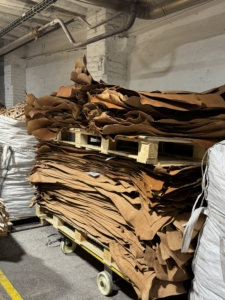
“Tanning is a process that converts a putrescible organic material into a stable material that resists decomposition caused by microorganisms, thereby increasing its durability”
Elisabetta Scaglia
Head of Environmental Services and Specifications, UNIC – Concerie Italiane.
This stabilisation does not remove leather’s natural origin — it changes however, the chemical nature of the fibrous collagen structure so that it remains stable, flexible, and durable. Its use in consumer products allows them to be used for many years, reducing waste and avoiding premature disposal.
Tanning Chemistry vs Biodegradability:
Clearing the Confusion
One of the most widespread misconceptions is that tanning relies on so many chemicals that leather must then be “sealed” with a heavily plasticised finish — effectively turning leather into plastic. This is incorrect.
What Tanning Does:
● crosslinks collagen fibres by means of vegetable, mineral or synthetic tannins depending on the end-use (shoes, bags, gloves, furniture…)
● improves resistance to heat, moisture, and mechanical stress thanks to selected performance chemicals
● by definition when a surface coating or surface layer is applied to protect “leather” it cannot be thicker than 0,15mm, otherwise it has to be called “coated leather” and even in such a case the coating cannot be thicker than 1/3 of the total thickness of the material.
What Tanning Does NOT Do:
● it does not convert leather into a synthetic material
● it does not eliminate its natural, protein-based structure
It is true that after tanning, the surface of leather has to be protected to allow for longtime usage, and in many cases this is done with a synthetic layer. But this layer is very thin (< 150 µm). Therefore, normally < 5% of the leather in use is based on plastic.
As a result, despite the use of chemicals and protective layers, a sustainable leather today contains >90% natural based materials, allowing for far better biodegradability performance compared tomany other so-called biobased alternatives.
Biodegradability in Practice
Biodegradable materials are substances capable of being broken down by microorganisms (bacteria, fungi, algae) and natural elements (sun, water, oxygen) into non-toxic, natural components like water, carbon dioxide, and biomass. As Elisabetta Scaglia explains:
“Biodegradation is the metabolic conversion of an organic material into simpler natural elements through the action of microorganisms under suitable environmental conditions.”
A material with a higher proportion of bio-based chemistry may have a greater propensity for biodegradation but the two terms cannot be used interchangeably. More broadly, all leather is biodegradable in principle. However, for leather to biodegrade – like other natural materials (e.g. wood) – it needs the right conditions, which do not normally occur during use. The rate of biodegradation depends heavily on the environmental conditions and the presence of appropriate microorganisms.
What varies is the speed of degradation, depending on the tanning and finishing chemistry that is used.
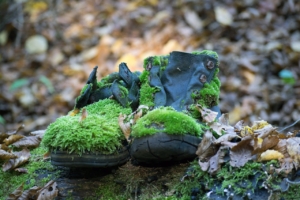
Biodegradation does not occur while leather is being used, because the necessary conditions — sustained moisture, microbial activity, temperature, and oxygen — are typically absent. At the end of life, however, these conditions can enable biological breakdown. If leather as waste ends up in the environment, the degradation process starts for all its bio-based components.
Why This Matters for Sustainability and Circularity
Durability and biodegradability position leather as:
-
A long-lasting material that prevents premature waste of its manufactures, promoting slow flashion.
-
A bio-based product that can return to natural cycles at end of life depending on the chemistry used
-
A source of inspiration for hte development of a science-based circular economy
As EU policies increasingly focus on ecodesign & sustainability, circularity, and lifecycle thinking, it is essential that decisions are informed by facts, scientific evidence, and system-level analysis.
Durability and biodegradability in leather are not contradictions – they are complementary properties of this natural, bio-based material that just needs public support to develop its full potential.
Edited by

In collaboration with

